

Capacitors
Capacitors are passive electronic components that are used to construct electronic oscillators, filter unwanted signals, and create tone-shaping circuits, among other things. A capacitor is formed whenever two conductors are separated by an insulating material such as plastic or air. The insulating material is called a dielectric. The choice of dielectric affects the size and capacitance of the capacitor.
Early capacitors were large and leaky, and used dielectrics (like oil-soaked paper) that were susceptible to environmental damage. Later capacitors have more sophisticated construction, smaller packaging, and plastic dielectrics that are more resistant to changes in temperature and humidity.
The availability of capacitors has a major influence on the layout and physical construction of the amplifier. Large, expensive capacitors had a higher cost per component, but they also presented second-order costs because they required a larger chassis and more elaborate mounting systems. For applications that require a lot of capacitance, such as power supply filtering, the size and expense of capacitors made it necessarily to find a compromise between cost and performance.
Part no.: 78701
Part name: Capacitor - interference suppressor
Date of drawing: September 20 1983
Pages: 1 of 1
Diazo print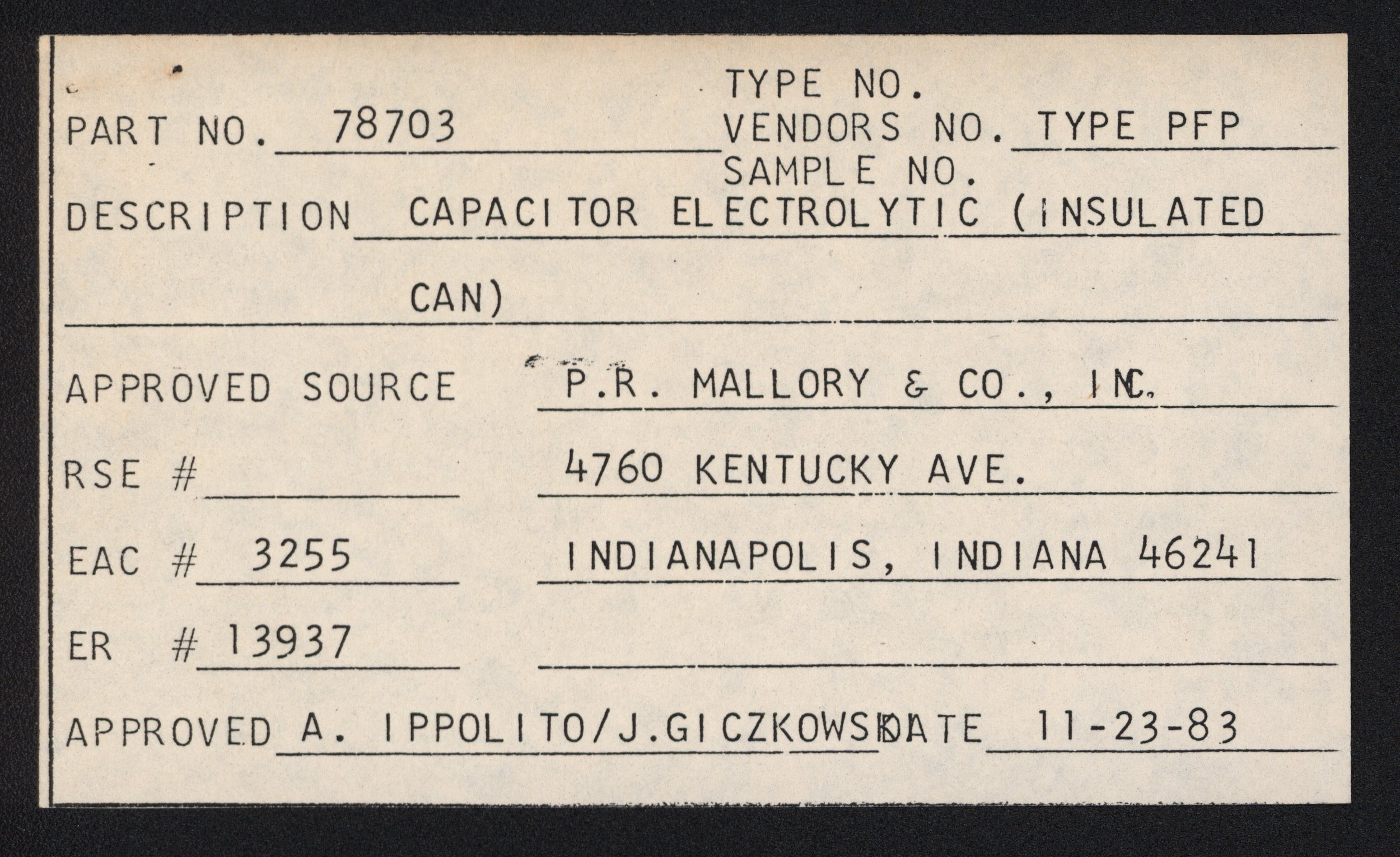
Part no.: 78703
Part name: Capacitor - electrolytic
Date of drawing: October 3 1983
Pages: 1 of 1
Diazo print
Approved source card (1)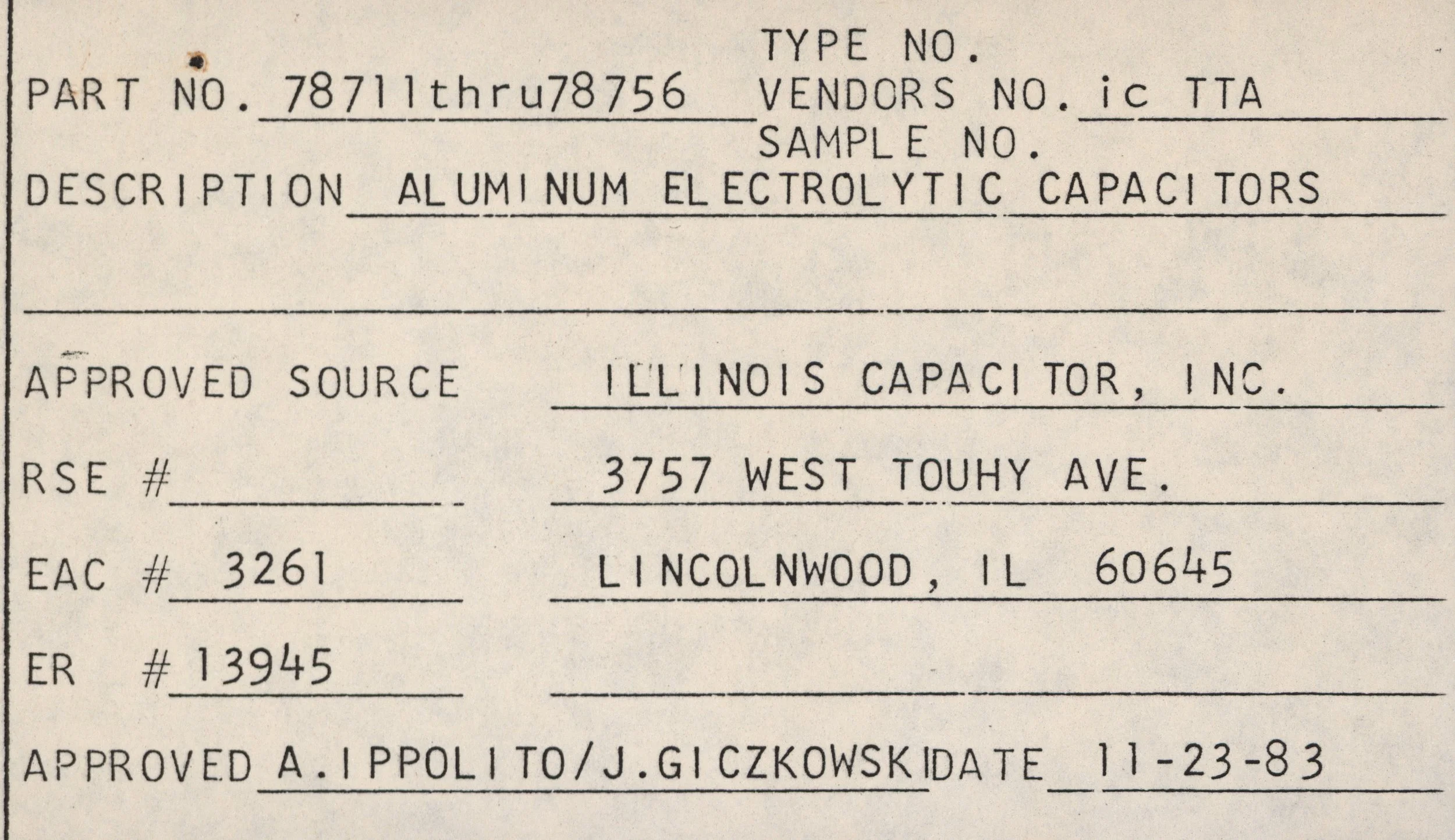
Part no.: 78711 thru 78756
Part name: Aluminum electrolytic capacitors
Date of drawing: October 26 1983
Pages: 3 of 3
Diazo print
Approved source card (1)