

Fuses
Fuses are safety devices used to protect against overcurrent conditions. Each fuse is composed of an inner conductor that is enclosed in glass or metal housing. The inner conductor is designed to melt when exposed to a certain level of current. When the fuse melts, the circuit opens and current will no longer flow. This effectively turns the circuit “off”, protecting the rest of the components and limiting further damage to the circuit. Fuses are a sacrificial device and must be replaced once blown.
Fast blow fuses are designed to melt immediately when exposed to the rated current. Slow blow (time delay) fuses are designed to withstand overcurrent conditions for a certain period of time, and are used whenever large inrush currents are expected. Mains fuses are often slow blow, because the brief current spike that occurs when a device is turned on would melt a fast blow fuse.
Fuses are usually encased in glass, which allows for visual inspection of the internal conductor. Panel mounted fuses allow fuses to be inspected and replaced by the user. These are typically mains fuses, which can blow for reasons other than amplifier fault, such as faulty power cords, power surges, or due to age. Other types of fuses are mounted inside the amplifier. Pigtail fuses have hardwired leads that are designed to be soldered into place, but ordinary glass fuses can be used internally if they are mounted in the appropriate fuse holder.
Part no.: 500755
Part name: Fuse - slow blow
Model: N/A
Date: March 5 1959
Diazo print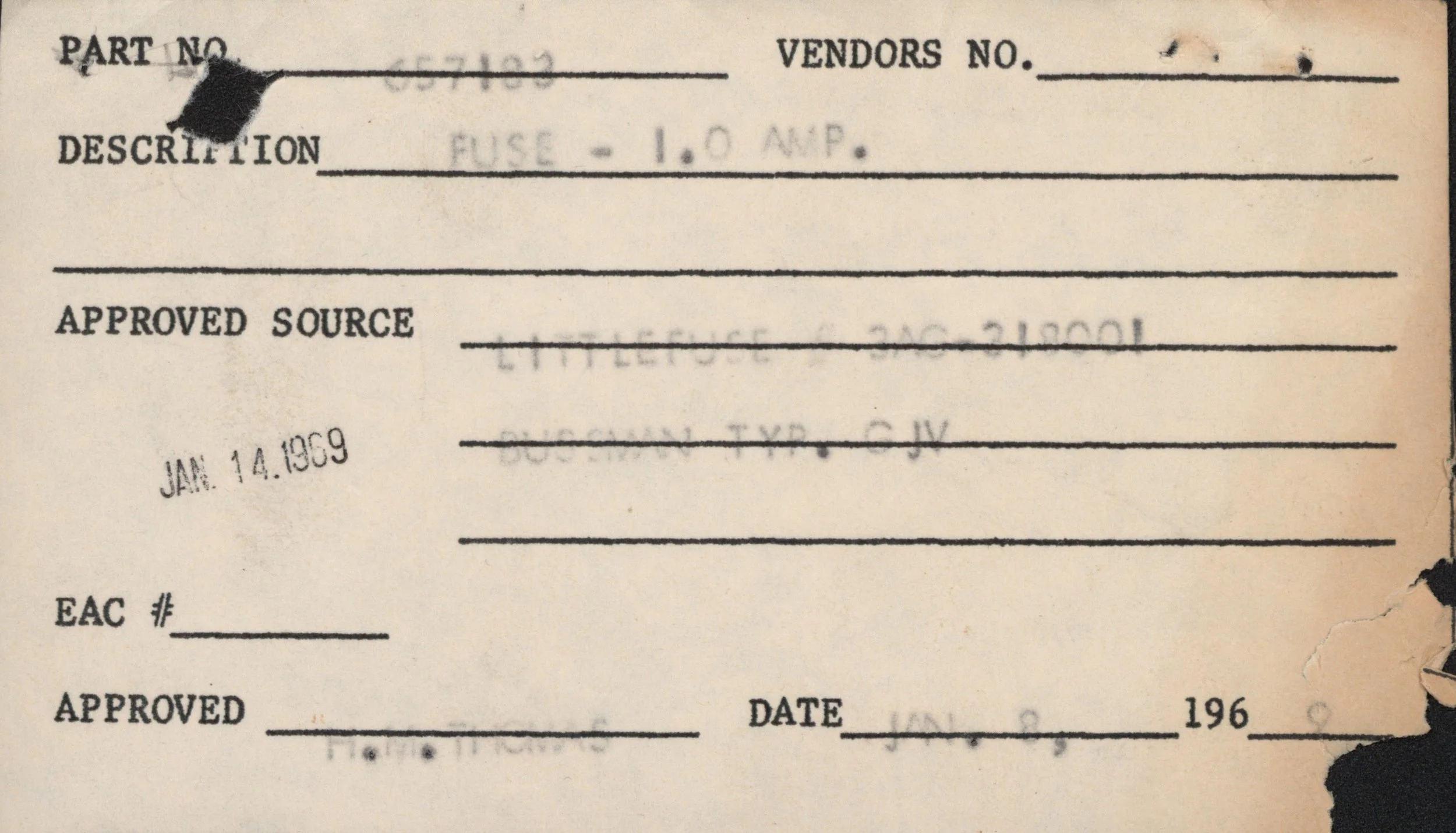
Part no.: 657183
Part name: Fuse - fast blow
Model: N/A
Date: January 8 1969
Diazo print
Parts History Record (1)
Material Evaluation Report (1)
Approved source card (1)Part no.: 45352
Part name: Fuse post
Model: Phono & organ
Date: May 13 1958
Diazo print